
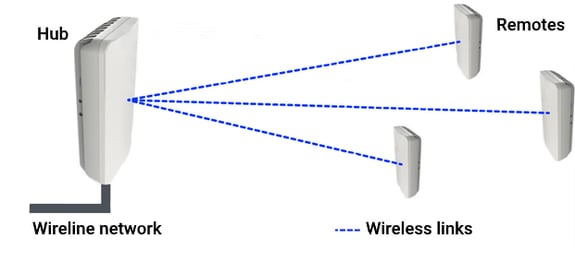
K60 units in a Point-to-Multipoint (PtMP) wireless network
Altowav wireless networks take advantage of the high capacity of the 60 GHz frequency band to provide scalable gigabit connectivity. The K60 unit is designed for outdoor use and works well for multiple applications, including gigabit access, optical fiber extension, IoT backhaul (sensors, security, cameras, etc.), as well as corporate and enterprise data communications.
Adaptive beamforming with an integrated antenna array, as well as flexible mounting options and scan angles (90˚ horizontal / 30˚ vertical) help to ensure reliable connectivity and simplify installation of the units for non-technical staff.
Generally, a K60 network consists of the following components:
- Hub(s): One or more units assigned a hub (distribution) role. Hubs control wireless communication to one or more remote units.
- Remote(s): One or more units assigned a remote (client) role. Remotes scan for available hubs and connect. Remotes may be configured to connect only to a preferred hub, to align with specific network plans and policies.
- AltoCommand (optional): Provides tools for network planning, provisioning, configuration, management, monitoring and fault isolation. AltoCommand is recommended for networks of medium and large scale.
Each K60 unit can be configured to operate in either a hub or remote role.
Altowav’s K60, K60x, K60c, K60c+ and K60i units are designed to be interoperable in order to provide further flexibility in network configurations.
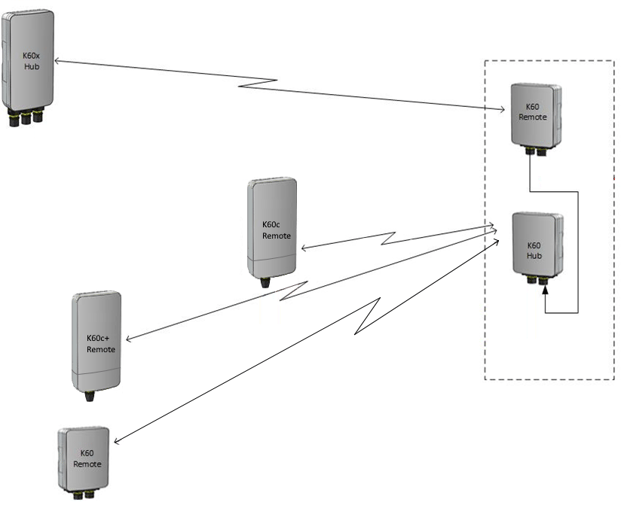
Example of K60, K60x and K60c/c+ units used together
Ethernet Switching Function
Designed to seamlessly integrate into existing Ethernet networks, the system is built for Ethernet connectivity services and provides network functionality as a standard Layer 2 (L2) Ethernet Switch (IEEE 802.1d). Each K60 cluster (one hub with its group of up to eight remotes) acts as a distributed switch, with the Ethernet ports on the hub and linked remotes acting as switch ports.
The embedded switch functionality performs Media Access Control (MAC) address learning (up to 4096 MAC addresses). This function allows a hub to optimize radio resources by sending traffic to the remote associated with the traffic’s destination.
The K60 system allows network management traffic to be encapsulated in a dedicated management VLAN and can transport standard Ethernet frames, including oversize frames (up to 1596 bytes including the FCS).
System Specifications
The following table describes the Altowav System specifications.
|
System Specifications |
|
|---|---|
|
Aggregate wireless capacity |
Up to 1.8 Gbit/sec (Layer 2/ Ethernet). |
| Ethernet frame type | Transparent bridging of all Ethernet types including VLAN and VLAN stacking. |
| Latency | >250 µs typical. |
| L2 switching | Complete Layer 2 switching with VLAN support. |
| Security | AES 128 with automatic secure key distribution. |
| Network attributes | Ethernet switch, 802.1Q, DSCP/ToS/802.1p (IPv4/v6) and 802.1ad/ QinQ tagging. |
| Network interfaces |
K60: Two GbE RJ-45 ports, Port 1 with PoE in and Port 2 with up to 30W PoE output. K60x: Two 2.5 GbE RJ-45 ports, Port 1 with PoE in and Port 2 with up to 30W PoE output. One GbE RJ-45 port, Port 3 with up to 15W PoE output. K60c c+: One GbE port. |
| Other interfaces | LED indicator for power, link condition, signal strength, and unit location. |
| Provisioning | Zero-touch deployment and provisioning available with optional AltoCommand. |
| Management | |
| Wireless Standard | 802.11ad. |
System Throughput
The K60 system is based on the IEEE 802.11ad standard. It uses time division duplexing (TDD) access mode, employing a single frequency for both transmit and receive paths. The throughput for the downlink and uplink depends on a downlink-to-uplink frame bandwidth ratio. The ratio is automatically adjusted based on the offered load in each direction, taking into account all remotes connected to a hub in PtMP.
The system’s throughput depends on the Modulation and Coding Rate (MCS) which varies according to link and signal conditions. The following table details Ethernet uplink and downlink combined throughput for a K60 link.
|
Throughput Performance for Cyclic Prefix of 1/8 |
|||||
|
MCS Index |
Modulation |
NCBPS |
Repetitions |
Code Rate |
Data Rate (Mbit/s) |
|
1 |
π/2 BPSK |
1 |
2 |
1/2 |
310 |
|
2 |
π/2 BPSK |
1 |
1 |
1/2 |
620 |
|
3 |
π/2 BPSK |
1 |
1 |
5/8 |
775 |
|
4 |
π/2 BPSK |
1 |
1 |
3/4 |
930 |
|
5 |
π/2 BPSK |
1 |
1 |
13/16 |
1007 |
|
6 |
π/2 QPSK |
2 |
1 |
1/2 |
1240 |
|
7 |
π/2 QPSK |
2 |
1 |
5/8 |
1550 |
|
8 |
π/2 QPSK |
2 |
1 |
3/4 |
1860 |
At higher elevations, the 60 GHz frequency provides some enhanced performance due to lower oxygen density.